
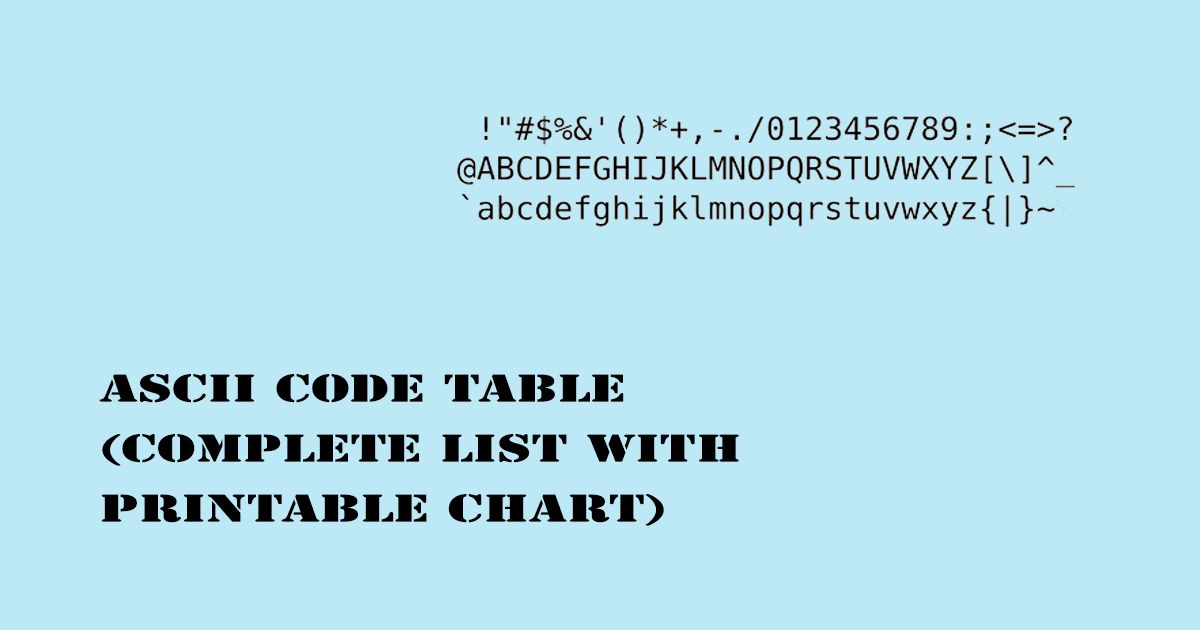
ASCII Code Table
( Complete List with Printable Chart )
Quick Answer
ASCII code table is a standard character encoding system that assigns numeric values to letters, digits, and symbols. Each character has a unique ASCII value from 0 to 127, enabling computers to store and display text consistently across systems and applications.
Summary
This complete guide covers the ASCII code table with characters, decimal values, and usage examples. It includes printable charts, explanations, conversion tips, and practical use cases for students, developers, and IT professionals. 📊
What is ASCII code?
ASCII (American Standard Code for Information Interchange) is a character encoding standard used to represent text in computers. Each character like letters, numbers, and symbols is assigned a unique numeric value, making it possible for machines to process and display text data efficiently.
How does ASCII code work?
ASCII works by mapping characters to numerical values. For example, the letter “A” is represented by 65, and “a” is represented by 97. Computers store these values in binary form and convert them back into readable text when needed. ⚙️
Who should use ASCII codes?
ASCII codes are widely used by programmers, developers, students, data analysts, and IT professionals. They are essential for understanding text encoding, data transmission, and low-level programming concepts. 💻
ASCII Code Table (0–127 Complete List)
| Decimal | Character | Description |
|---|---|---|
| 0 | NUL | Null character |
| 1 | SOH | Start of heading |
| 2 | STX | Start of text |
| 3 | ETX | End of text |
| 4 | EOT | End of transmission |
| 5 | ENQ | Enquiry |
| 6 | ACK | Acknowledge |
| 7 | BEL | Bell |
| 8 | BS | Backspace |
| 9 | TAB | Horizontal tab |
| 10 | LF | Line feed |
| 11 | VT | Vertical tab |
| 12 | FF | Form feed |
| 13 | CR | Carriage return |
| 32 | Space | Blank space |
| 33 | ! | Exclamation mark |
| 34 | " | Quotation mark |
| 35 | # | Hash |
| 36 | $ | Dollar |
| 37 | % | Percent |
| 38 | & | Ampersand |
| 39 | ' | Apostrophe |
| 40 | ( | Left parenthesis |
| 41 | ) | Right parenthesis |
| 48 | 0 | Digit zero |
| 49 | 1 | Digit one |
| 50 | 2 | Digit two |
| 51 | 3 | Digit three |
| 52 | 4 | Digit four |
| 53 | 5 | Digit five |
| 54 | 6 | Digit six |
| 55 | 7 | Digit seven |
| 56 | 8 | Digit eight |
| 57 | 9 | Digit nine |
| 65 | A | Uppercase A |
| 66 | B | Uppercase B |
| 67 | C | Uppercase C |
| 68 | D | Uppercase D |
| 69 | E | Uppercase E |
| 70 | F | Uppercase F |
| 97 | a | Lowercase a |
| 98 | b | Lowercase b |
| 99 | c | Lowercase c |
| 100 | d | Lowercase d |
| 101 | e | Lowercase e |
| 102 | f | Lowercase f |
| 127 | DEL | Delete |
Extended ASCII Codes (128–255)
Extended ASCII includes additional characters beyond 127, such as special symbols, accented letters, and graphical characters. These are used in different encoding systems but may vary across platforms. 🌐
ASCII vs Unicode Comparison
| Feature | ASCII | Unicode |
|---|---|---|
| Character Limit | 128 | Over 1 million |
| Usage | Basic text | Global languages |
| Encoding | 7-bit | Multiple formats |
Real-Life Examples
Example 1: ASCII value of 'A' is 65. 🔤
Example 2: ASCII value of '0' is 48. 🔢
Example 3: ASCII is used in programming and data storage. 💻
Checklist for Using ASCII Codes
- Understand decimal values
- Use correct encoding format
- Verify compatibility
- Learn common values
Common Mistakes to Avoid
- Confusing ASCII with Unicode ❌
- Using incorrect values ❌
- Ignoring encoding differences ❌
- Assuming all characters exist in ASCII ❌
Process Flow: How ASCII Works
Input character → Convert to ASCII value → Store in binary → Process by system → Convert back to text → Display output. 🔄
Download ASCII Code Table PDF – Complete Printable Chart
Get the free ASCII Code Table PDF containing ASCII values 0–127, decimal, hexadecimal, octal and binary conversions, control characters, printable characters, A–Z, a–z, numbers, symbols and a one-page printable ASCII cheat sheet.
Download ASCII Code Table PDF
PDF • ASCII 0–127 • Decimal + Hex + Binary + Octal • Printable Chart • Updated 2026
Complete ASCII code table from 0 to 127 with characters, control codes, decimal, hexadecimal, octal and binary values. Download the printable ASCII chart PDF for students, programmers and developers.
ASCII code table | ASCII code chart | ASCII table PDF | ASCII values 0-127 | printable ASCII chart | ASCII decimal table | ASCII hexadecimal table | ASCII binary table | ASCII control characters | ASCII codes A-Z | ASCII codes a-z | ASCII character codes | ASCII symbols | ASCII decimal hexadecimal conversion | complete ASCII table
Internal Resources
📌 Similar guides: Windows, Excel and Browser Keyboard Shortcuts, HEX and RGB Color Codes, Screen Sizes and Resolutions, File Size Conversion Chart
Explore more guides at Important Codes, Lists & Reference Guides.
External Resources:
Conclusion
ASCII code table is a fundamental concept in computing that helps represent text in digital systems. Understanding ASCII improves programming knowledge and data handling skills. 💡
Explore more useful guides at Important Codes, Lists & Reference Guides.
Suggested Post
- Keyboard Shortcuts for Windows, Excel and Browser
- Color Codes: HEX and RGB Chart
- Screen Sizes and Resolution List
- File Size Conversion Chart
Frequently Asked Questions (FAQs)
What is ASCII code?
ASCII is a character encoding system that assigns numeric values to text characters.
How many ASCII characters are there?
There are 128 standard ASCII characters.
What is extended ASCII?
Extended ASCII includes additional characters beyond 127.
What is ASCII used for?
ASCII is used in programming, data storage, and communication systems.
Is ASCII still used today?
Yes, ASCII is still used as a base for modern encoding systems.